
Table of contents
5. Take a Stand on the Events of the Revolution of Dignity
This activity can be carried out in a classroom, at school, or in a museum.

Target group: Young people aged 15-25, teachers, and youth workers.
Duration: 30-40 minutes
Group size: 10-30 people
Activity objective
To show that controversial issues do not have simple answers and may be interpreted in different ways. The activity also helps participants clarify their attitudes toward controversial issues related to the Revolution of Dignity by creating a space where different viewpoints and arguments can be heard.
Expected learning results
The participants will:
- Recognize the complexity of controversial issues and the diversity of perspectives on historical events;
- Express their positions on complex issues and support them with valid arguments;
- Practice active listening and respect for viewpoints different from their own.
- Develop an understanding that changing one’s mind in response to arguments is a sign of critical thinking, not weakness;
- Recognize the importance of dialogue and diversity of opinions in a democratic society.
Description of the activity
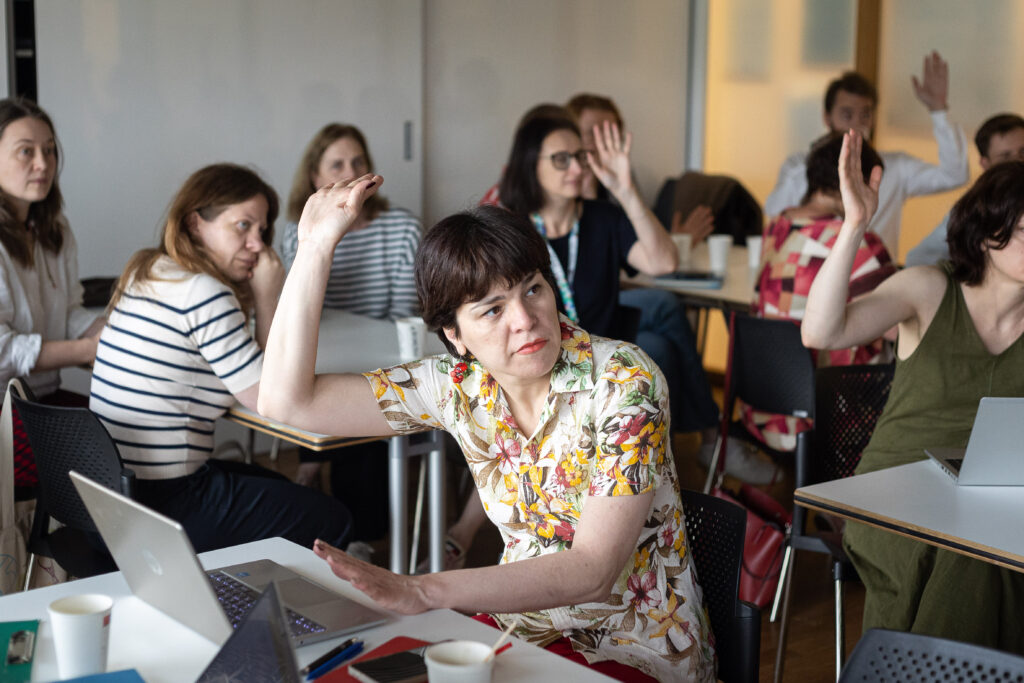
Participants receive various statements about the Revolution of Dignity. They are asked to reflect on their position on each statement and then take a place in the room that best represents their stance. In this activity, not only are the statements themselves important, but also the way participants listen to arguments and show respect for other people’s opinions. Therefore, participants can change their perspective and move to a different place in the room during the activity.
1. In the four corners of the room, place cards in the room that say “I strongly agree,” “I partially agree,” “I partially disagree,” and “I strongly disagree.” Explain that the participants will hear a list of statements. They should take a position that represents their attitude toward each statement. Tell the participants that there are no right or wrong responses in this activity.
2. Read the statements one by one, inviting participants to take their respective positions—moving to the corresponding part of the room (e.g., to “strongly agree” or “strongly disagree”). Once everyone has taken their places, ask participants to explain their choices (for example, 1 or 2 representatives from each group). After listening to the explanations (arguments), participants may decide to change their position. Remind them of this possibility. You can ask them gently why (under the influence of which arguments) they decided to do it.
3. After all statements have been discussed, invite everyone to sit in a circle to reflect on the activity.
List of statements
- The Revolution of Dignity began after riot police beat people who were protesting against the reversal of Ukraine’s pro-European course.
- Law enforcement bodies have the right to use force against peaceful protesters if ordered to do so by their commanders, since they have pledged allegiance to the state.
- Under no circumstances do protesters have the right to resort to violence, such as seizing administrative buildings, throwing paving stones, or using Molotov cocktails against law enforcement officers.
- Participation in EuroMaidan and the Revolution of Dignity was driven by the same demands.
- Young people were the main driving force behind the protests from November 2013 to February 2014.
- The Revolution of Dignity revealed a divide within Ukrainian society between those who supported European integration and those who envisioned Ukraine as part of a common space with Russia.
- The Revolution of Dignity had a positive impact on the development of a responsible civil society in Ukraine.
- The Revolution of Dignity ended after President Yanukovych fled the country.
- The Revolution of Dignity would not have occurred if Russia had not interfered in Ukraine’s internal affairs.
- Russia would not have started a war against Ukraine if the Maidan had failed.
Reflection

- Do you think there are right or wrong answers in this activity? Why?
- Did the conflicting opinions affect your perspective? If so, how exactly? If not, why not?
- Were there any statements on which everyone took the same position? Which statements were they, and why do you think that happened?
- Were there any statements on which the group’s opinions were most divided? Which statements were they, and why do you think this happened?
- Is it helpful to have different views on certain issues? Why?
- Were there any statements on which you found it difficult to take a position? If so, why?
- Чому в демократичному суспільстві важливо слухати одне одного?
- Why is it important to listen to each other in a democratic society?
Tips for teachers/ educators
Your role is that of a facilitator, not a judge or an expert. Do not impose your perspective, even if it seems self-evident to you. Balance all positions. The process is more important than the outcome—the main thing is not the ‘right answer’ but a training in the art of dialogue.
Before you start the activity, remind everyone to respect different views and that the class/group should be a safe space for anyone to express their views. Emphasize that there are no right or wrong answers—there are different perspectives, and they all have a right to exist. Establish a rule: criticize ideas, not people.
Encourage participants with different positions to express their opinions during the activity, but do not force anyone to speak. If one person dominates the discussion, thank them for their contribution and invite others to join in: “It would be interesting to hear from those who haven’t spoken yet.” Keep track of time and avoid spending more than 5 minutes on a single statement.
Notice and support those who change their position—this is an act of courage and critical thinking. If someone stands alone, thank them for the courage to have their opinion. Do not allow the group to pressure the minority or those who are undecided.
If a conflict arises, stop the activity and remind everyone of the rules. Ask participants to rephrase their thoughts without emotional bias. Emphasize that we may disagree with ideas, but we must respect people.
Required materials
- A room or other area large enough for participants to move around freely;
- Sheets of paper with the phrases “I strongly agree,” “I partially agree,” “I partially disagree,” and “I strongly disagree” printed or clearly written on them;
- A list of statements (these can be displayed on a slide so that participants have time to read them. It is important that these statements appear one after another, rather than all at once);
- Chairs for everyone to sit during the reflection session.
Authors/Copyright
Lesia Onyshko, Kateryna Romanova, and Khrystyna Chushak
This activity is based on “Where do you stand?” described in Compass: Manual for Human Rights Education with Young People, revised edition. CoE, 2015 (see https://www.coe.int/en/web/compass/where-do-you-stand-).
Suggestions for activity development
You may add a fifth option, “I haven’t decided,” and place it in the center of the room. You can then ask those gathered around this label to choose a position after hearing the arguments or explanations from other participants who have already taken a position. It is important not to pressure these participants and to allow them to remain where they are.
At the end, in active and advanced groups, you may ask participants to propose their statements and ask the group for its opinion.