
Table of contents
7. Do we have to serve in the army?
This activity can be carried out in a classroom, or in a museum.

Target group: High school students – ages 16-20
Duration: 45-60 minutes
Group size: Average class – max 30 students
Activity objective
Students will:
- Take into consideration different modes of thinking;
- Look at the dilemmas that people from their community/family have without judgment;
- Learn to discuss controversial issues in a socially accepted manner.
Expected learning results
After completing this task, students will:
- develop critical thinking skills;
- know how to come to a balanced decision;
- conclude deep deliberation;
- Respect different ways of thinking and reacting to emotionally engaging problems.
Description of the activity
Introduce the topic of the workshop. I.e, you can connect it to the dilemmas that have arisen with the war situation in Ukraine and possible conflict of Russia with other European countries. Ask a question: What happens if mandatory universal military service is introduced in our country.
Explain to students that their task is to come up with a poster that analyzes a situation when everyone in their society gets conscripted at a certain age and for a certain time. Explain to them the procedure of discussion. Say, that the method used in this activity is called “Six Thinking Hats”. Its idea is that each participant will receive a certain colour-coded role and should “think” about the issue discussed only from the perspective of this role.
Divide the students into groups of six (for instance, by putting papers of 6 different coulours (black, white, blue, red, yellow, and green) into some container or a hat and asking the students to draw their role. In this way, each student receives a “way of thinking” about the dilemma.
Next, form groups of six — each group consisting of participants with different colors.
It is important to give very clear instructions to each participant of the activity; you might want to print them out at coloured papers used for distributing these colour-coded roles to students.
Roles
- White Hat: Focuses on objective information, facts, and data.
- Red Hat: Allows for the expression of emotions, feelings, and intuition without justification.
- Black Hat: Encourages critical thinking, identifying potential problems, risks, and weaknesses.
- Yellow Hat: Emphasizes positive aspects, benefits, and optimism.
- Green Hat: Stimulates creativity, new ideas, and explore alternatives.
- Blue Hat: Manages the thinking process, sets the agenda, and ensures focus and organization.
If you have resources, paper hats of 6 colours can be made and later worn by the participants. If not, ask them to wear ‘their’colour somewhere other can see (on a badge, stick it to their clothes etc).
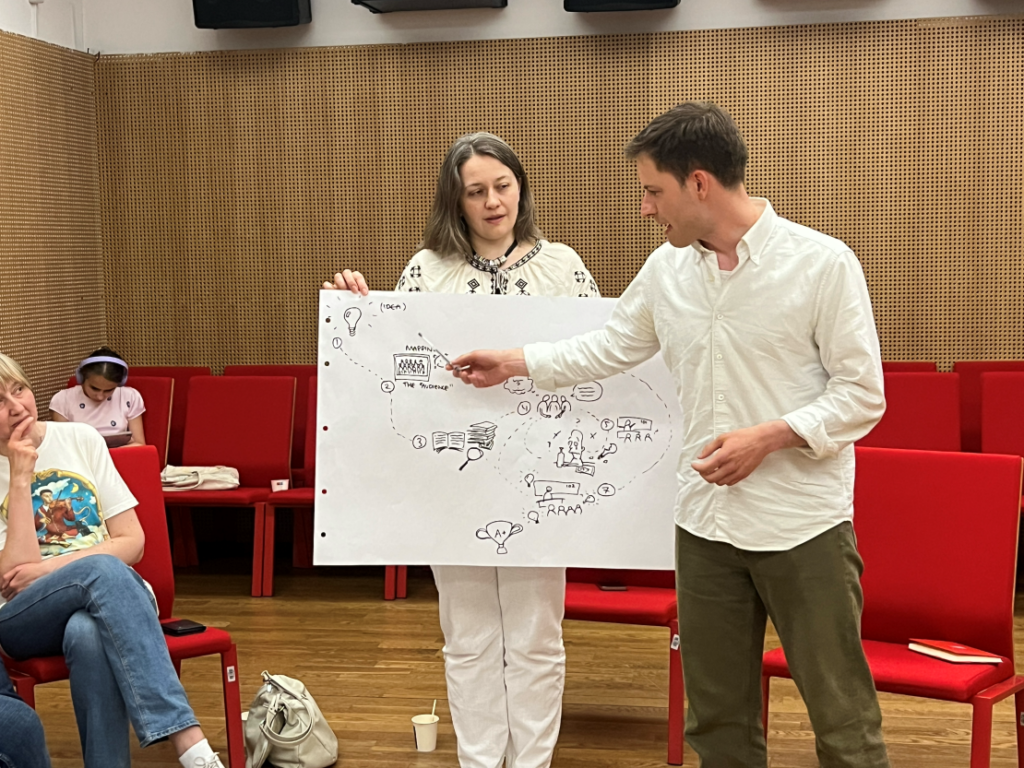
Students work on the task of discussing the situation when mandatory universal military service is introduced in our country, and making a poster that analyses this situation from the different perspectives (roles) that they received. Emphasize the role of the blue hat: to moderate this discussion, to make sure that the poster is ready in time, to make sure that all voices and perspectives were presented and heard. Give them 15 to 20 minutes to prepare posters.
After all the groups are ready with their posters, hang them on the wall, and let the students walk around and read their classmates’ thoughts (5-10 minutes). You can also give them an additional tasks – i.e., note arguments that they like or that were not used in their group, etc,
Then ask them to sit in a circle and lead a debriefing. If they had hats or coloured papers on them, you can ask them to take those off and ‘let go’of their roles.
Reflection
Please, choose questions the most appropriate for your group.

- How did it feel to step into a forced role and think only from the perspective of your assigned color?
- Was it difficult to put aside your personal opinion if it contradicted your hat’s role?
- How did the different hats alter the narrative of the same topic?
- For the Blue Hats: How challenging was it to manage the discussion, keep your group on track, and ensure that every hat’s voice was equally integrated into the final poster?
- When reading the other posters, did you notice any arguments or points that your own group completely missed?
- What surprised you the most in the ideas, fears, or benefits you heard from your classmates or read on the posters?
- How did the Red Hat (emotions/intuition) and the Black Hat (risks/weaknesses) change the tone of the conversation compared to the White Hat (objective facts)? Why are all of these layers necessary when a society discusses military duty?
- In real life, what factors (such as family background, personal values, or media) might cause someone to naturally adopt a “Black Hat” (risk-focused) or “Yellow Hat” (benefit-focused) outlook on military service?
- What does this activity show about how every individual reacts differently to emotionally engaging problems?
- How can a society come to a balanced, deeply deliberated decision regarding conscription if it ignores either the emotional perspective (Red Hat) or the structural facts (White Hat)?
- Military service and war are highly controversial issues. What did you learn today about how to discuss polarizing topics in a respectful, socially accepted manner?
- How can you apply the skills developed today – like pausing your initial emotional reaction to gather facts or look at risks – the next time you encounter a divisive topic on social media or in news reports?
Tips for teachers/ educators
If you do not know this method, please read more about it: https://en.wikipedia.org/wiki/Six_Thinking_Hats
To fully benefit from this method, young people need to use this method several times. Try to use it with the same group for discussing a similarly complex & controversial issue some time soon after this activity.
Required materials
- Sheets of paper in 6 colors (preferbaly, with the roles explained / printed on them) – the number of copies should be adjusted to the number of students in the class.
- Flipchart paper for each group & flipchart markers.
- If possible, prepare paper hats of 6 colours or think about some other way to make coloured roles visible to all the participants.
- The room with tables and chairs that move; enough chairs for everyone present and enough room to make a large circle for a debriefing so everyone could see everyone.
Authors/Copyright
Monika Koszyńska