What is the Whole School Approach?
The whole school approach is a joint effort by the administration, teachers, students, parents and local community members, aimed at comprehensive learning and practice through the implementation of democratic principles and respect for human rights in all spheres of school life.

School is the best place for children to learn about democracy as an idea, but also as an experience.
A democratic school teaches democracy in practice and through the way in which it operates. In the school community, children live in a diverse society. And we seek to educate them to become active, participatory and democratic.
In this effort, the school needs to become an inclusive, safe place of learning where all people, regardless of their background, enjoy the right to education. We therefore need to account for and work on all dimensions of school reality.
In the Council of Europe defines the whole school approach through three key areas:
1) Teaching and learning
2) School governance and culture
3) Cooperation with the community
As teachers, we spend most of our time in the classroom. So do children. The classroom is a place of teaching and learning, for everyone. We teach and at the same time learn from the newest members of society, who are in touch with what novel things interest and attract them.
We don’t promote democracy if classroom practice requires obedient and silent students. Cultivating democracy in practice means active and participatory students, as well as flexible teachers who know how to listen. The classroom is one of the key small communities where children gain the experience of democracy.
But school life does not begin and end in the classroom. In the daily schedule there are breaks and gaps, excursions and celebrations. These events are also related to learning as they shape the atmosphere of the school.
Walking through the school gates, we quickly become aware of the school’s atmosphere. There are strict, silent, rowdy, happy schools. The relations between the Principal and the teachers, and all of them with the children, give a certain character to the daily life of the school.
No matter how much we strive to create an inclusive atmosphere in the school, if its management is not democratic, if all members of the school community are not activated, involved and practicing democratic values, we fight in vain.
No matter how much the school focuses on lessons, the outside world influences it both positively and negatively. Parents are the bridge between the school and the community, as are the people working in the community surrounding the schools. By taking into account their professional qualities and interests, they can become more actively involved in and useful for the school.
The whole school approach encourages experiencing democracy and human rights in action through a supportive school environment built on respect for human dignity, human rights and democracy, with opportunities for equal participation in school governance for all members of the education process.
It has proved to successfully address challinging school issues at like violence, bullying and integration of minorities.
At the European Wergeland Centre, we use the whole school approach because it helps to develop competences for democratic culture and is recognised as effective worldwide, promoted by the Council of Europe, UNESCO and other international organisations. It is often mirrored in national education documents as a way to promote inclusive and safe learning environments and achieve learning excellence.
The whole school approach is based on learning “about”, “through” and “for” democracy and human rights. It means that democracy and respects for human rights are manifested in all aspects of school life, from how the school looks like to how its community works and cooperates.
What do we need for successful implementation of the approach?
- Joint participation of all members of the education process to make sure their needs are met. Not only within the curriculum, but throughout the educational environment, understanding and taking into account the social, political, economic and demographic contexts in which schools operate. Strategic planning and implementation of current plans, with the involvement of all members of the education process.
- Taking into account and recognising the importance of the role of each school community member in supporting the educational journey of students and their learning experience, partnership and interaction between all members of the educational process and other stakeholders to improve learning, behaviour, students wellbeing and factors that contribute to this.
Learning democracy at school requires a close interaction and collaboration of all stakeholders in different areas of school life.
Who are school community members/stakeholders?
School community members/stakeholders are all that studies, works, influences or are influenced by the school: administration and staff, school teachers, students, parents and caregivers, as well as local community representatives.
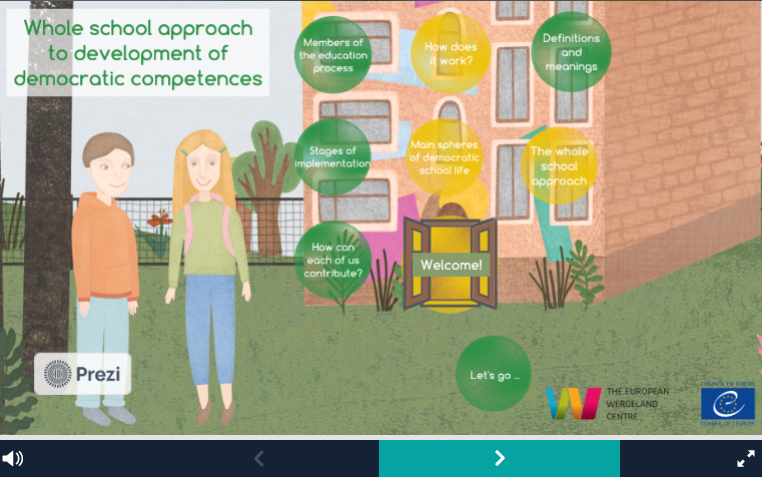
The most important feature of the whole school approach is that all members of our school community are invited and empowered to participate in everyday school life. Active and meaningful participation by each of these stakeholder, based on the principles of democracy, is essential to implement the whole school approach and create a democratic culture at school.
Democratic institutions are essential to provide a safe and democratic learning environment for learners. Here, young people might not only gain knowledge and trust in democratic principles and mechanisms, but also acquire the skills and self-confidence on their own capacity to influence on institutional and community affairs.
Why is participation the key?
All participants of the education process share the same goal: to improve the school and make it a safe, inclusive and demoracitic learning environment for all students. How to achieve this goal? Let’s look at three possible situations at school:
- When teachers are very active, but are they only ones to take the initiative to create change. Teachers do a lot of work, but without the involvement and participation of other school members, it may not be appreciated. Over time, teachers get discouraged, burned-out or lose the desire to initiate change.
- When only administration representatives initiate change, make decisions and distribute tasks, activities are carried out as planned, but without participation there is no feeling of belonging to the school community. Responsibility for change and its implementation is not shared. There may be a sense of disempowerment as all decisions are made by the leaders, and not every idea or need is taken into account.
- When everyone is involved in planning and implementing change, participants of the education process understand why change is needed and what results they want to achieve. They participate in planning and implementing initiatives for change, practice teamwork and their accomplishments are appreciated by all. In this way, they practice the whole school approach. But there is more to it.

The whole school approach encourages work in three core areas of school life:
- Integrating democracy and human rights into the teaching and learning process
- Building a democratic environment and governance at school
- Establishing partnerships with parents and the local community
Teaching for democracy and human rights can be facilitated when:
- The school integrates topics and educational approaches of democratic citizenship and human rights into the curriculum across all subjects.
- Extracurricular activities are aimed at studying and promoting democracy and respect for human rights.
- The school employs learner-oriented participatory and democratic teaching methods.
Democratic school culture and governance foresee that:
- The school culture is democratic and inclusive.
- School governance includes all stakeholders.
- Relations and interactions among school community reflects democracy and respect for human rights.
- Conflicts are resolved peacefully with the involvement of all parties.
Cooperation with parents and the local community:
- Representatives of the school take part in the life of the local community. Partnerships with the local administration and with organisations in the local community are established.
- Parents are viewed as partners and involved in school governance.

How to implement the whole school approach to shape a safe, inclusive and democratic learning environment, and develop the students’ democratic competences?
All school stakeholders can contribute with some efforts to improve democracy at school and help students develop as active and responsible citizens.
Teachers can:
- Integrate education for democracy and human rights education into the curriculum.
- Encourage open discussions in the classroom, making sure that each student is involved and heard.
- Apply the methods and principles of formative assessment.
- Encourage the work of the student parliaments.
Students are encouraged to:
- Join the work of student governance bodies, such as the student council.
- Volunteer in local organisations or community and school projects
- Establish civil society organisations or grassroot groups, or become their members.
- Initiate interest clubs.
The administration can:
- Delegate decision-making power to collegial governing bodies and public self-government.
- Ensure that decisions affecting the school is discussed and decided upon with the involvement of all members of the educational system.
- Create a system for such engagement and facilitate it.
- Facilitate development of a shared vision for school development.
Parents and caregivers in school can:
- Take a genuine interest in school life.
- Participate in parental self-government bodies
- Contribute to the development of competences by leading master classes, lessons, or extracurricular activities in and outside of the school
We can cooperate with local community members and organisations in order to:
- Involve students in joint projects
- Encourage teachers, students and parents to participate in community development
- Participate in development and implementation of the local youth and education policies.